
Mapleton Vineyard sits on rolling northern facing slopes at Tea Tree, in the Coal River Valley. Three buildings, spread across several hundred metres of working vineyard, all needing internet. One satellite dish, a long range WiFi booster covering roughly 30 acres, two point to point wireless links and a set of indoor access points later, the whole property now runs on a single network with one name and one password.
This is how that job came together, and why the same approach works for a lot of Tasmanian rural businesses.
| Location | Mapleton Vineyard, Tea Tree, Tasmania |
| Type | Commercial, cellar door and vineyard |
| Services | Starlink installation, long range WiFi distribution, point to point wireless links, indoor access points |
| Coverage | Around 500 metres in any direction from the main mast, roughly 30 acres |
| Buildings connected | Shed, main house (300 metres), restaurant (200 metres in the opposite direction) |
| Installed by | Michael Starling |
| Warranty | Three years |
The problem with connectivity on a working vineyard
A cellar door is a business, and a modern business needs a connection that does not drop out halfway through a card payment.
The trouble on a property like Mapleton Vineyard is not just getting internet to the front gate. It is getting it to every place where work actually happens. The tasting bar needs it for payments, bookings and the point of sale system. The kitchen and restaurant need it for orders and reservations. The house needs it for everything a house needs it for. And the vineyard itself, the part between the buildings where nobody has ever run a cable, needs it for phone calls.
That last one is the piece people underestimate. Coal River Valley properties often sit in patchy mobile coverage. Staff walking the rows, a delivery driver trying to find the right shed, a contractor calling in from the far block, all of them are out of range of the router in the office and, quite often, out of range of a usable mobile signal too.
Running fixed cabling between three buildings spread over 500 metres is expensive, disruptive to a working vineyard, and hard to justify. Buying three separate internet connections is worse. What the property needed was one good connection and a proper way of spreading it around.
Why Starlink was the starting point
Tea Tree has no realistic fixed line option for this kind of load, which is the situation across most of rural Southern Tasmania. Starlink solves the first half of the problem straight away. Its low earth orbit satellites sit at around 550km, compared with roughly 36,000km for a traditional geostationary satellite, so the latency is low enough for video calls, card terminals and cloud based booking systems to behave normally.
The catch is that a Starlink dish on its own only ever gives you internet in one spot. The router inside the dish kit is built for a house, not for a vineyard. Plenty of rural property owners install Starlink themselves, get a good speed test standing next to the router, then find the signal disappears before they reach the shed door.
So the dish is step one, not the whole job.
Getting the equipment up high, and keeping it there
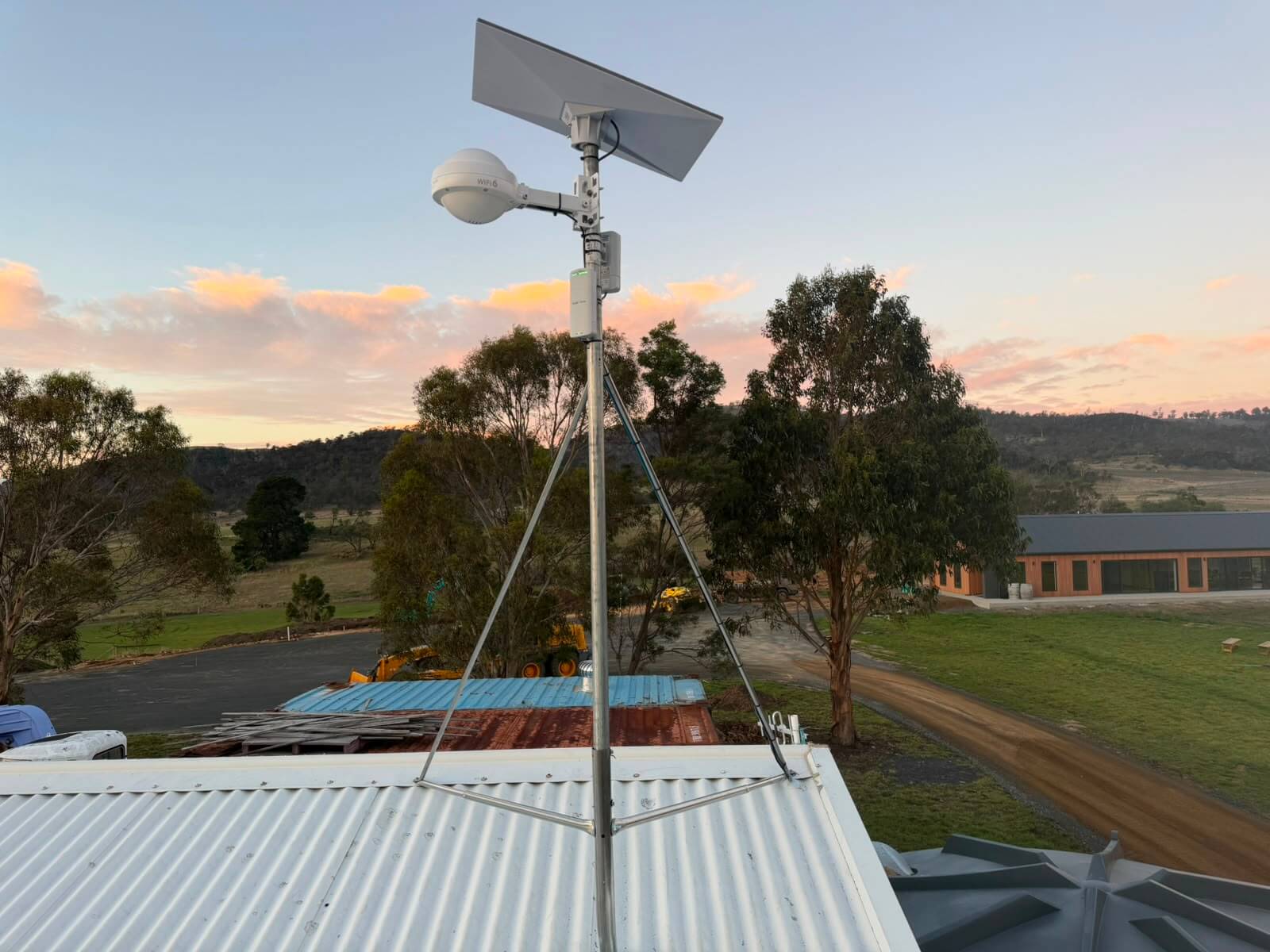
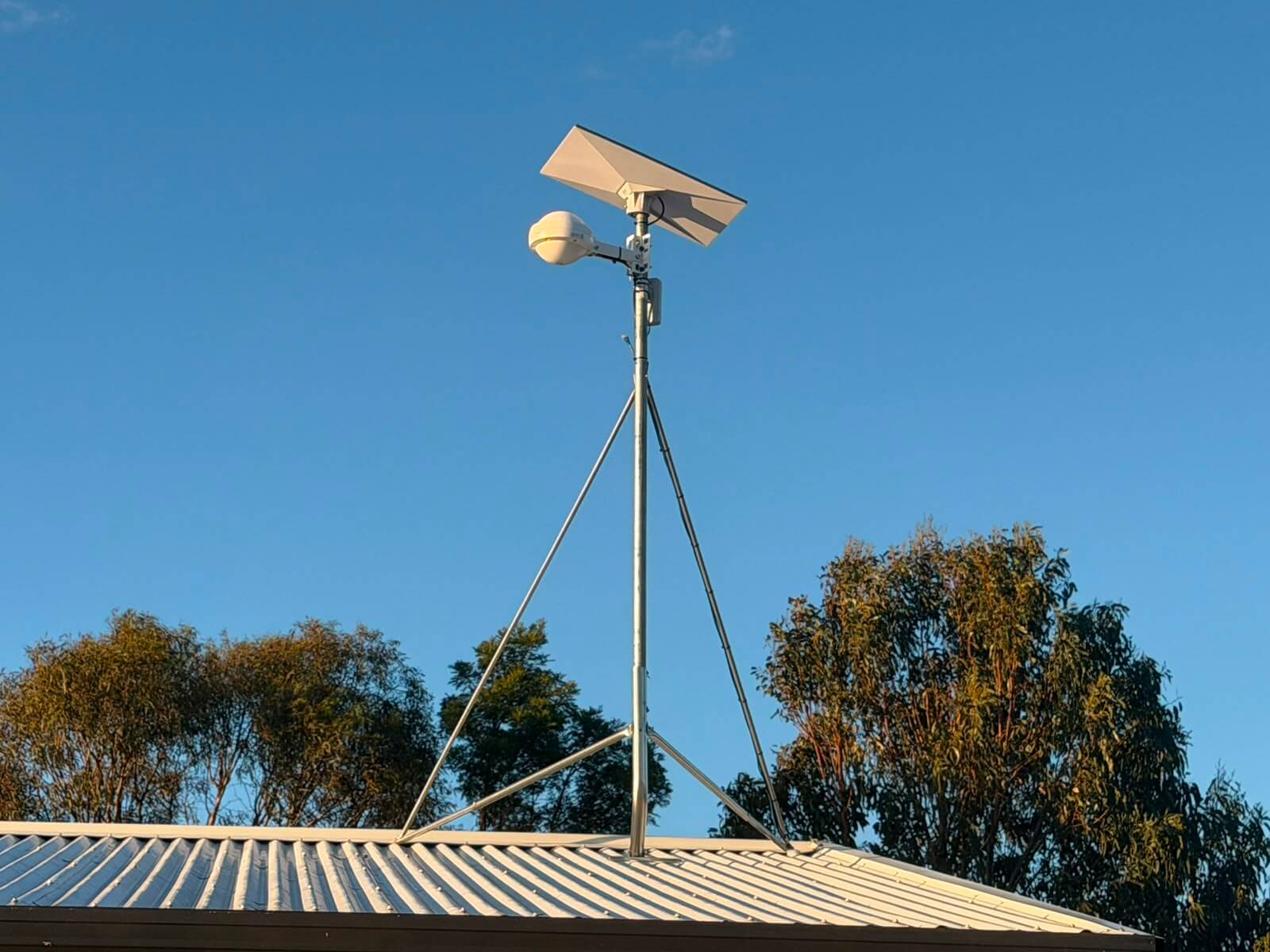
The Starlink dish and the main outdoor WiFi unit went onto a heavy duty mast on the shed roof, guyed off with a braced tripod base bolted through to the roof structure.
Height is not decorative. A dish needs a genuinely clear view of the sky, with no gum tree branches clipping the edge of the field of view, because a low earth orbit satellite is constantly moving across it. A tree that only blocks the view for forty seconds at a time still causes a dropout every time it happens. Getting the dish above the roofline and clear of the surrounding eucalypts is what turns a connection that mostly works into one you can run a business on.
Height matters just as much for the WiFi. Radio signal travels best with nothing in the way, so every metre of mast buys you real distance across open ground.
The other reason the mast is built the way it is comes down to where we are. Tasmanian wind loading is not gentle, and a mast carrying a flat dish is carrying a sail. Guy wires, a proper braced base and stainless fixings are the difference between a system that survives its first winter and one that ends up in the vineyard.
The 30 acre WiFi booster
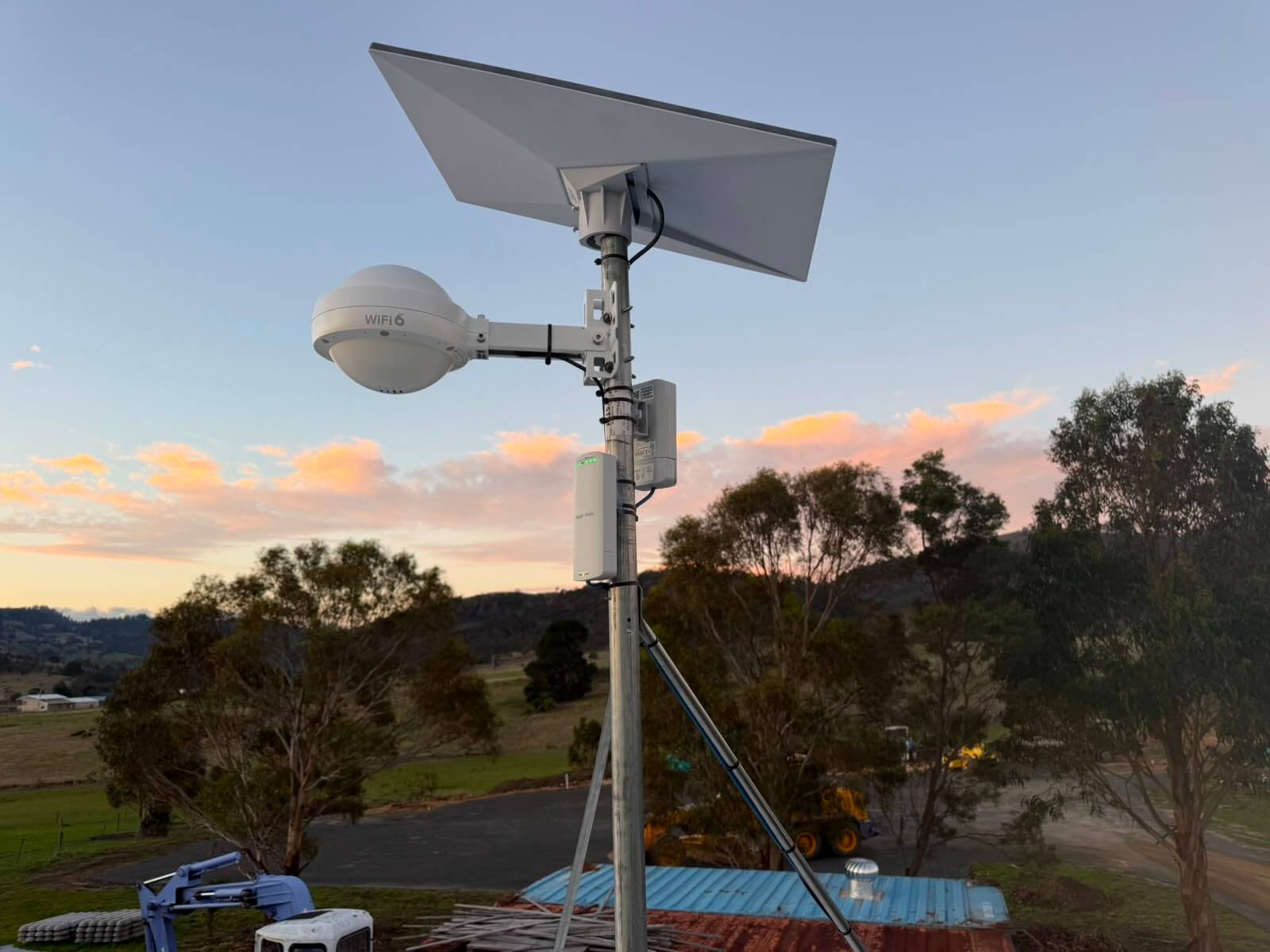
Alongside the dish on the same mast is an outdoor WiFi 6 access point, a Ruijie Reyee unit in a weatherproof dome, fed over a single cable that carries both data and power.
This is what we describe as a 30 acre WiFi booster, and it is the piece that does the heavy lifting outdoors. Mounted high and clear on the shed roof, it broadcasts usable WiFi around 500 metres in any direction. That covers the vineyard rows, the driveway, the car park, the machinery area and the open ground between all three buildings.
Real world range on any outdoor access point depends on terrain, tree cover and what the signal has to pass through, which is exactly why the position of the unit gets worked out on site rather than guessed. On this property, the northern facing slope works in its favour. Signal travels well downhill across open vines.
Two things that surprise people about outdoor coverage on a farm. First, it is not a repeater plugged into a power point in the corner of the shed. That approach halves your bandwidth at every hop and falls apart past about fifty metres. Second, it does not need a cable trench. One cable up the mast, and the rest is radio.
Point to point links to the house and the restaurant
WiFi in the paddock is useful. WiFi inside all three buildings is what the business actually runs on, and for that you want a dedicated link rather than asking each building to grab a weak signal from the shed.
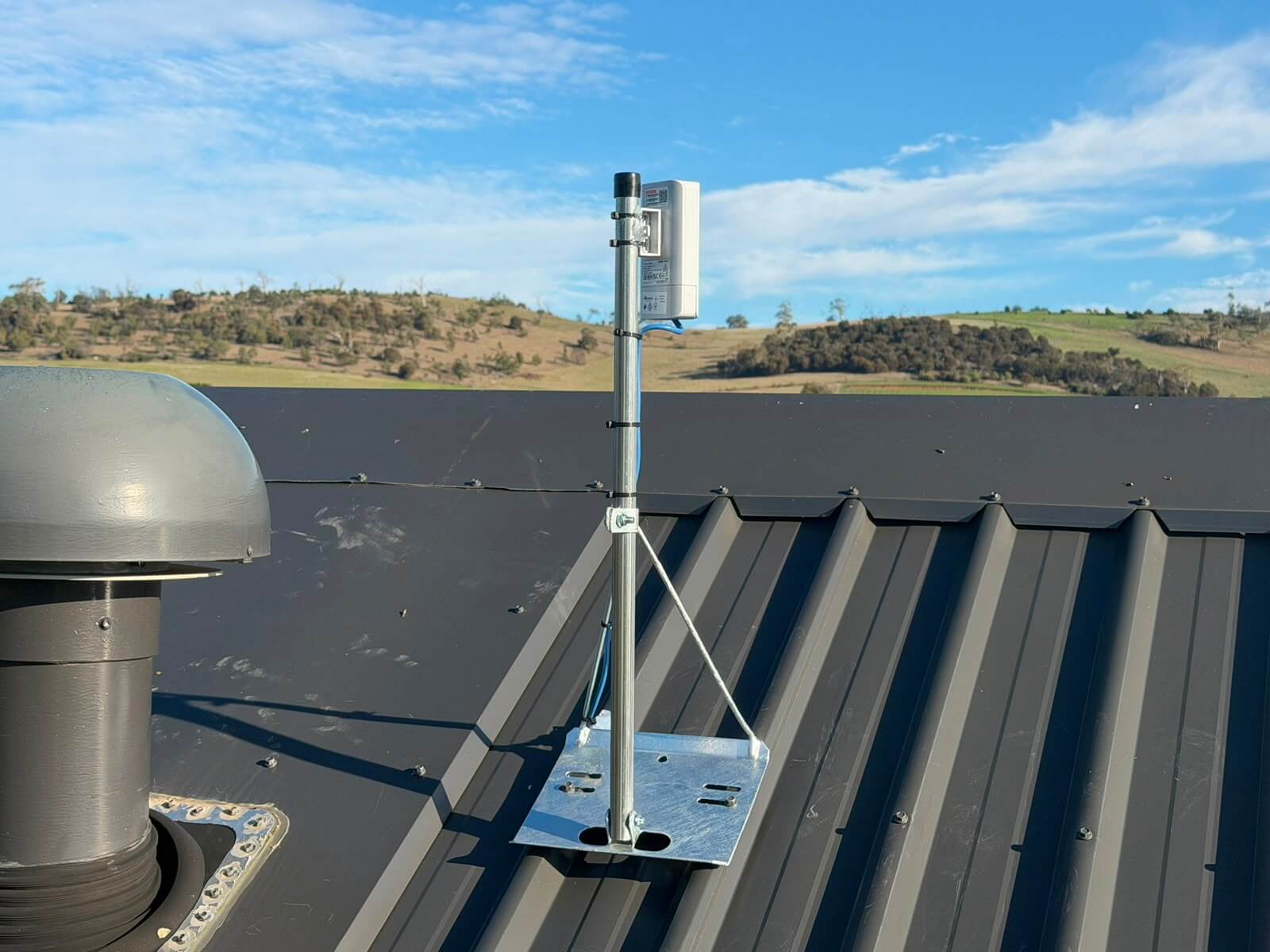
Two point to point wireless links were installed. One runs 300 metres to the main house. The other runs 200 metres in the opposite direction to the restaurant.
A point to point link is a matched pair of directional radios, one at each end, aimed straight at each other. Because the signal is focused into a narrow beam instead of being sprayed in all directions, the link is faster, more stable and far less bothered by interference than a general purpose WiFi signal covering the same distance. Each one is mounted on its own short mast on the building roof, sighted in, then aligned properly so the two ends are actually pointed at one another rather than approximately at one another.
Line of sight is the whole game with these. Get it right and a 300 metre link performs like a cable. Get it wrong, or let a row of trees grow into the path, and it does not work at all. That assessment is done on site before anything gets mounted.
Access points inside the three buildings
Each building then gets its own indoor access point, fed from the link that serves it.
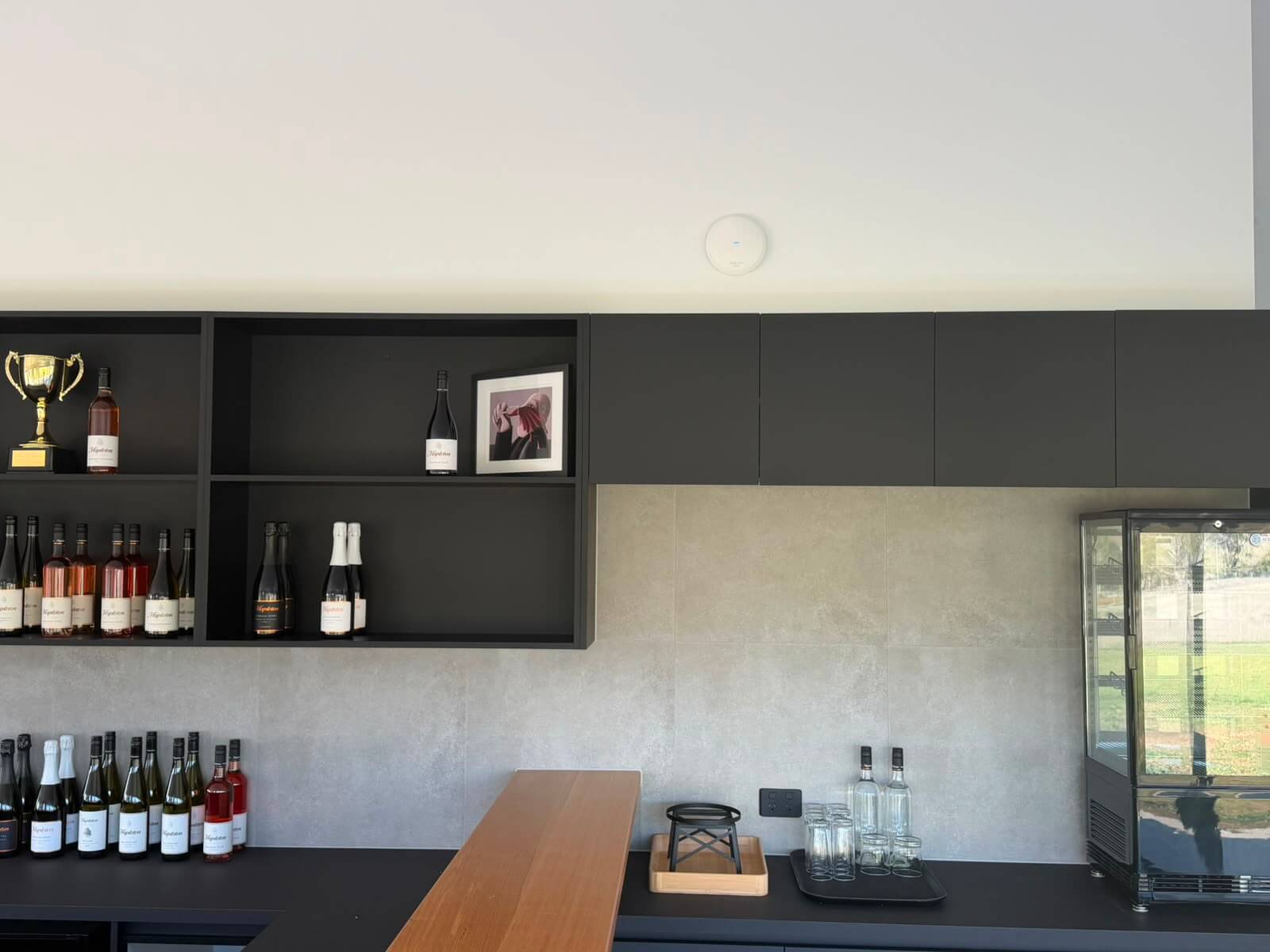
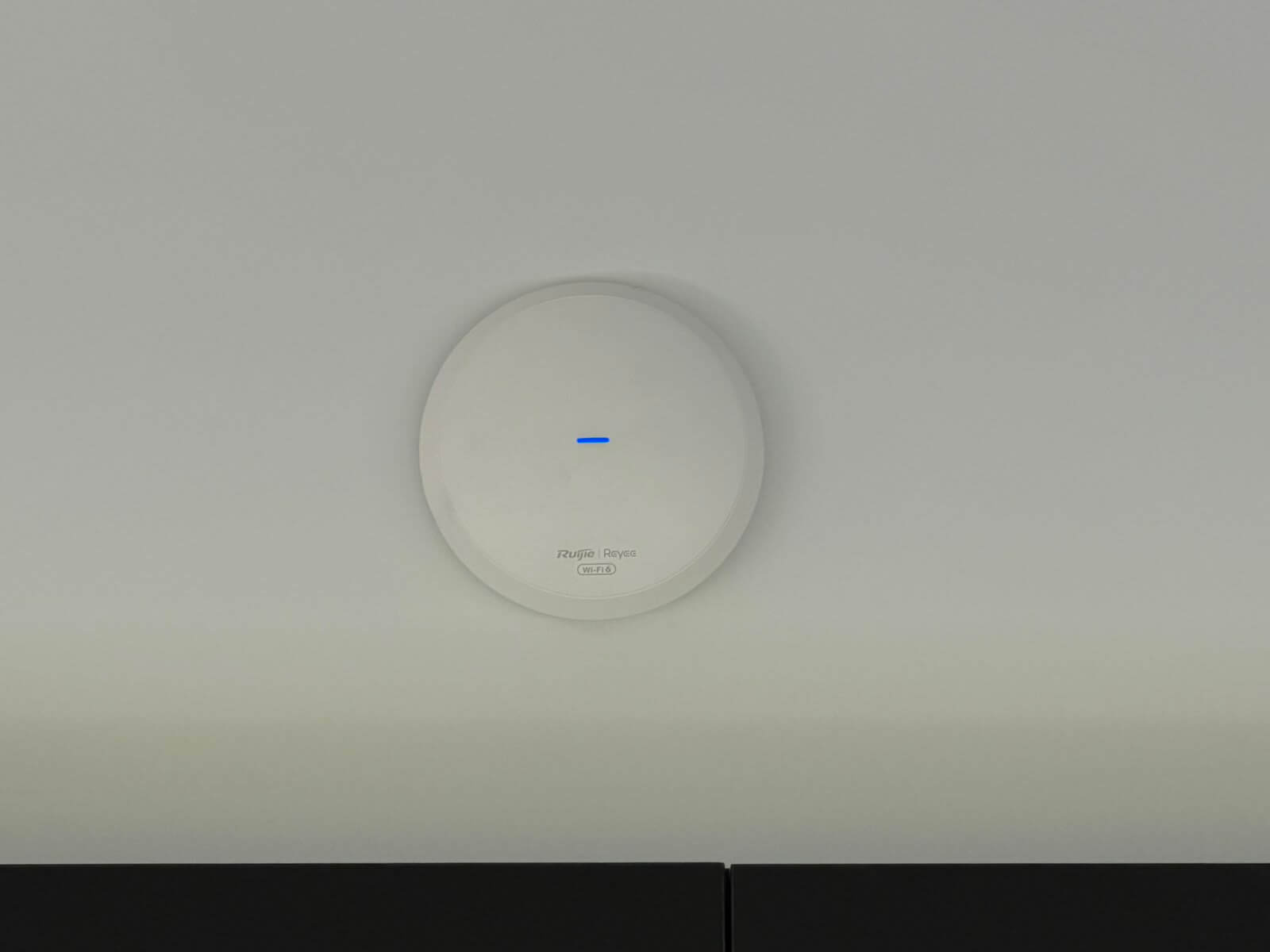
At the cellar door, that is a Ruijie Reyee WiFi 6 unit mounted flat on the ceiling above the tasting bar. It is white, it is about the size of a smoke alarm, and once it is up most people never notice it. That matters in a room that has been designed and finished properly. Nobody wants a plastic box and a coil of blue cable on the wall behind the wine.
The same approach was used in the house and the restaurant. Mount the access point centrally, get the cable in tidy, test the coverage in the corners of the room rather than standing underneath it.
One network, one name, one password
All of it, the outdoor booster, both point to point links and every indoor access point, is configured as a single network with the same WiFi name and the same password across the entire property.
This is a small detail that makes an enormous practical difference. Walk from the tasting bar out to the vines, then across to the restaurant, and your phone stays connected the whole way. No dropping off one network and hunting for another. No four different passwords written on four different bits of paper. Staff phones, the card terminal, the point of sale tablet and a customer phone all behave the same way anywhere on the property.
It also means one system to look after, and one thing to call about if anything ever needs adjusting.
WiFi calling across the property
The connectivity problem that most rural Tasmanian businesses would fix first, if they could, is mobile coverage. With WiFi now reaching around 500 metres in every direction from the shed, WiFi calling does that job.
Most current phones and most Australian carriers support WiFi calling. Once it is switched on, the handset routes calls over the WiFi network instead of the mobile network, so a phone that shows no bars will still make and take calls anywhere the WiFi reaches. On a property like this, that means the vineyard rows, the car park, the shed and the ground between the buildings all become places where a phone works properly.
It is worth checking that your carrier and handset support WiFi calling, and Michael can confirm this on site during the install.
The result
Mapleton Vineyard now has one internet connection serving three buildings and roughly 30 acres of vineyard, on a single network, with WiFi and WiFi calling right across the property. The cellar door, the restaurant and the house all run on the same system, and there is coverage in the space between them where there previously was none.
The whole install is backed by our three year warranty.
If you run a rural business in Southern Tasmania
The same setup suits a lot of properties around here. Wineries and cellar doors in the Coal River Valley, farm stays and accommodation, restaurants and function venues on rural blocks, packing sheds and workshops, and anywhere with a second dwelling or a building that has never had a cable run to it.
The pattern is nearly always the same. One well positioned satellite connection, one high mounted outdoor access point to cover the open ground, a point to point link for each outlying building, and an indoor access point in each one. Where there is a specific need, we can also separate a guest network from the business network so customer devices sit apart from your point of sale and back office systems, and we can add security cameras onto the same infrastructure without a second cabling job.
Michael holds ACMA Open and Restricted rule cabling registration with structured cabling, optical fibre and coaxial endorsements, so the data and cabling side is done to standard, not improvised.
If you have a property around Tea Tree, Richmond, Campania or anywhere in the Coal River Valley that needs internet in more than one building, give Michael a call on 0420 998 592 for a free quote. We cover Hobart, Southern Tasmania and the East Coast, seven days a week from 7am to 6pm.
Installed by Michael Starling
Owner and senior technician, Antenna Installation SpecialistsMichael has been installing Starlink and rural WiFi systems across Southern Tasmania since Starlink became available here, and holds ACMA Open and Restricted cabling registration with structured cabling, optical fibre and coaxial endorsements.
All work backed by a three year warranty. Sorell based. Call 0420 998 592 for a free quote.