
Signal Lost in the Valley
New Norfolk sits low in the Derwent Valley, ringed by hills on both sides of the river, and that same setting that gives the town its sheltered, historic character also means a terrestrial TV signal from the Hobart transmitters has higher ground to get around rather than a straight run in. This property, tucked in among close-set rooflines, had been living with a picture that broke up constantly and channels that came and went depending on the weather.
Why Position Matters More in a Valley Town
On flat or elevated ground, a slightly off antenna position often barely shows. In a valley like this one, where the signal is already working around terrain rather than travelling in a straight line, getting the mount height and aim right makes a far bigger difference to what actually comes through. Through our antenna installation we treated the aim as the main event rather than an afterthought.
Working Around a Tight Roofline
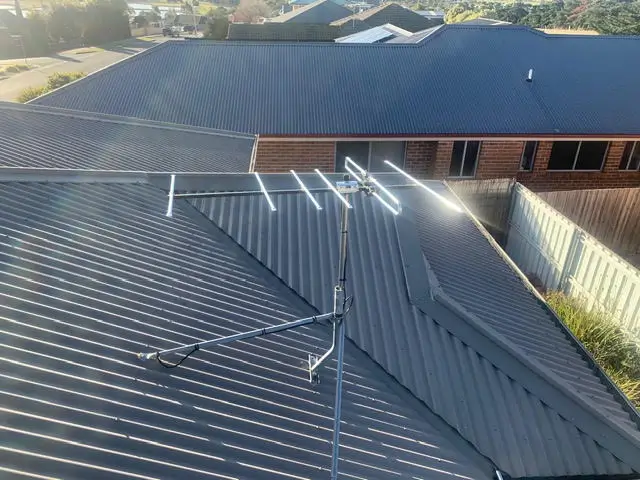
With the neighbouring roof sitting close by and the two properties nearly touching at the ridge, there wasn’t a lot of room to work with. We mounted the antenna on a mast fixed clear of the boundary line, keeping it well clear of the neighbouring roof while still holding a clean angle back toward the transmitter.
The Result
A stable, full digital picture that no longer depends on the weather or the time of day, finally making the most of what signal actually reaches a valley property like this one.
If You’re in New Norfolk
Homes throughout the Derwent Valley often deal with reception that’s more sensitive to positioning than a property on open or elevated ground, simply because of the hills the signal has to work around to get here. If your picture has never been particularly reliable, our antenna maintenance service can check whether a realignment would help before assuming new equipment is needed. Give Michael a call, or request a free quote to get it looked at.