
Muddy Puddles Childcare and Early Learning at Huonville runs out of a purpose built centre alongside the family home on the same block. Two separate buildings, one internet connection needed in both, and no practical way to run a cable between them.
The fix was a Starlink dish on the house, a point to point wireless link across to the childcare centre, and a ceiling mounted access point inside each building, all running as one network with a single WiFi name and password.
This is how that job came together, and why it is a pattern that suits a lot of childcare centres and early learning services in Southern Tasmania.
| Location | Muddy Puddles Childcare and Early Learning, Huonville, Tasmania |
| Type | Commercial, childcare and early learning centre, plus adjoining residence |
| Services | Starlink installation, point to point wireless link, indoor ceiling access points |
| Buildings connected | Main house and childcare centre |
| Network | Single WiFi name and password across both buildings |
| Installed by | Michael Starling |
| Warranty | Three years |
Why a childcare centre needs internet it can rely on
A childcare centre is not a place where the internet is a nice extra. It is where the paperwork lives.
Sign in and sign out is done on a tablet at the door. Attendance records feed the Child Care Subsidy claim. Daily observations, learning stories, photos, incident reports, medication records and nappy and sleep logs all go into an app that syncs to the cloud. Parents get updates through that same app during the day, and they notice quickly when the updates stop coming. Rosters, invoicing, enrolments and emails all sit on top of that.
When the connection drops, none of that stops being required. It just gets done twice, once on paper in the moment and again on a screen after hours. Educators end up doing admin at home instead of being with the children, which is the opposite of what the software was bought for.
Then there is the everyday side. Music for the room. A video call with a support agency or an early intervention therapist. A phone that actually works when a parent needs to be reached.
Huonville sits in the Huon Valley, about 35 kilometres south of Hobart, in the kind of terrain that makes all of this harder than it should be. Steep valley sides, heavy tree cover and properties spread out along the river. Plenty of blocks around here have patchy mobile coverage and no realistic fixed line option, and a centre operating on a residential grade connection with a router at the far end of the property is starting from behind.
Two buildings on one block, and the cable problem
The specific issue at Muddy Puddles was not just getting internet to the property. It was getting it to two separate buildings.
The main house and the childcare centre sit apart from each other on the same block. That is a very common setup for a family run centre, and it creates a decision that catches a lot of operators out.
The usual options are all poor. Run a trench and a cable between the buildings, which means excavation, reinstatement, and digging across ground that a childcare centre would rather not have dug up. Take out a second internet service for the second building, which means paying twice and managing two accounts. Or put a WiFi extender in a window and hope, which is what most people try first and what almost never works properly across that sort of distance.
None of those was the right answer here. What the property needed was one good connection at the best located building and a proper wireless link to carry it across.
Why Starlink, and why it went on the house
Starlink was the starting point because it removes the fixed line problem entirely. Its low earth orbit satellites sit at around 550km, compared with roughly 36,000km for a traditional geostationary satellite, so latency is low enough that video calls, card terminals and cloud based childcare software behave the way they do in town.
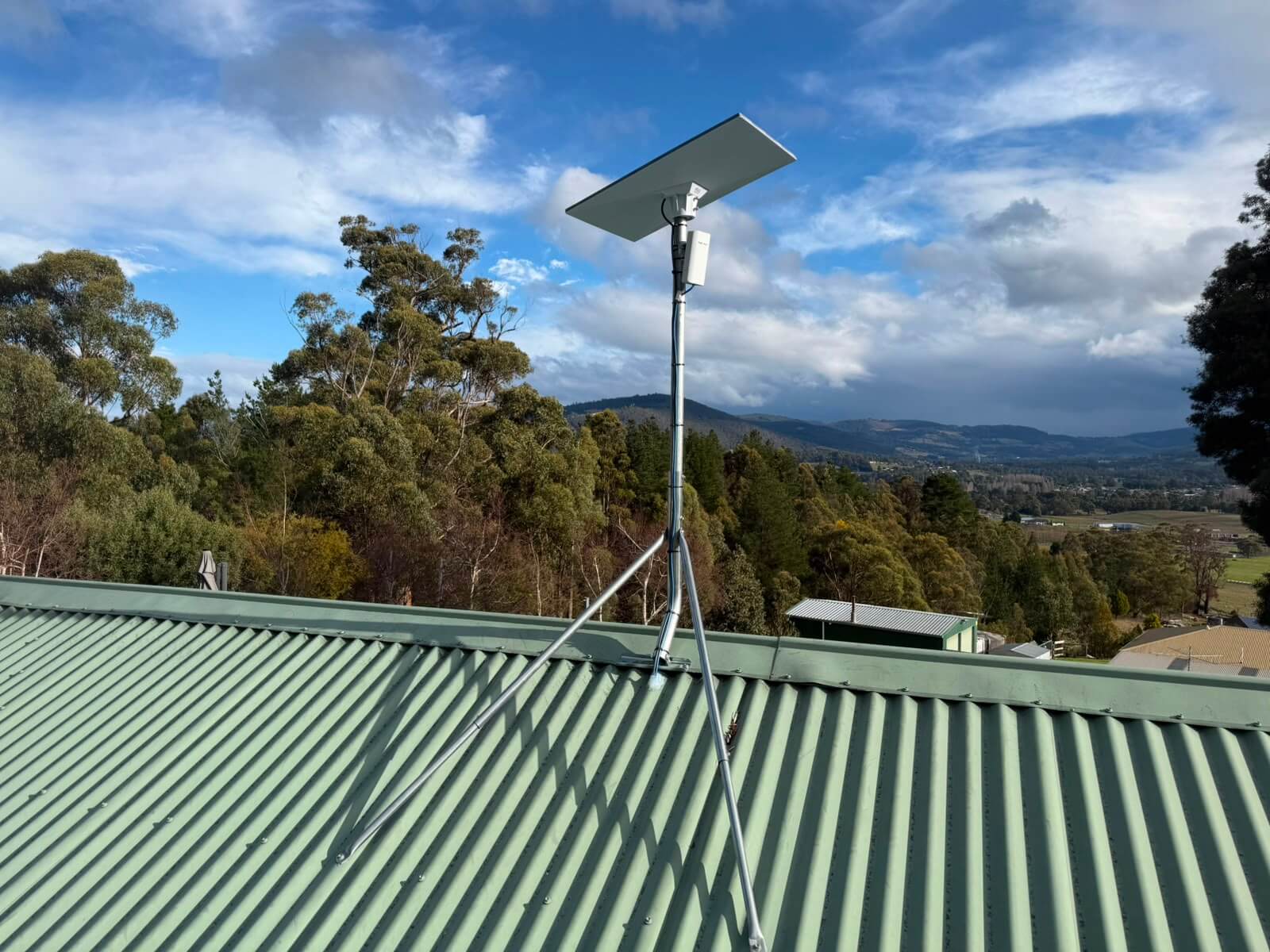
The dish went on the main house rather than on the centre, and that was a deliberate call made on site.
A Starlink dish needs a genuinely clear view of the sky, not just a patch of it. The satellites are constantly moving across the field of view, so a gum tree that only clips the edge of that view for forty seconds at a time still causes a dropout every single time it happens. In the Huon Valley, where mature eucalypts are everywhere and the ground rises steeply, finding the spot with the clearest sky is most of the work.
On this property the house roof sits higher and clearer, with open valley to the north. The centre roof, lower down and closer to the tree line, would have worked less well. So the dish went where the sky was, and the internet was carried to where it was needed.
That is the general principle on any multi building property. Put the connection where the signal is best, then move it, rather than putting the connection where you happen to want the internet and living with a compromised sky view.
The dish and the wireless gear are mounted on a heavy duty mast with a braced tripod base, bolted through to the roof structure and guyed off. That is not decoration. A flat dish on a mast is carrying a sail, and Tasmanian wind loading is not gentle. A properly braced and guyed mast with stainless fixings is the difference between a system that survives its first winter and one that ends up in the garden.
The point to point link across to the centre
With the connection landed at the house, a point to point wireless link carries it across to the childcare centre.
A point to point link is a matched pair of directional radios, one on each building, aimed straight at each other. Because the signal is focused into a narrow beam rather than sprayed in all directions, the link is faster, more stable and far less bothered by interference than a general purpose WiFi signal covering the same distance. Set up properly, it performs like a cable between the two buildings, without the trench.
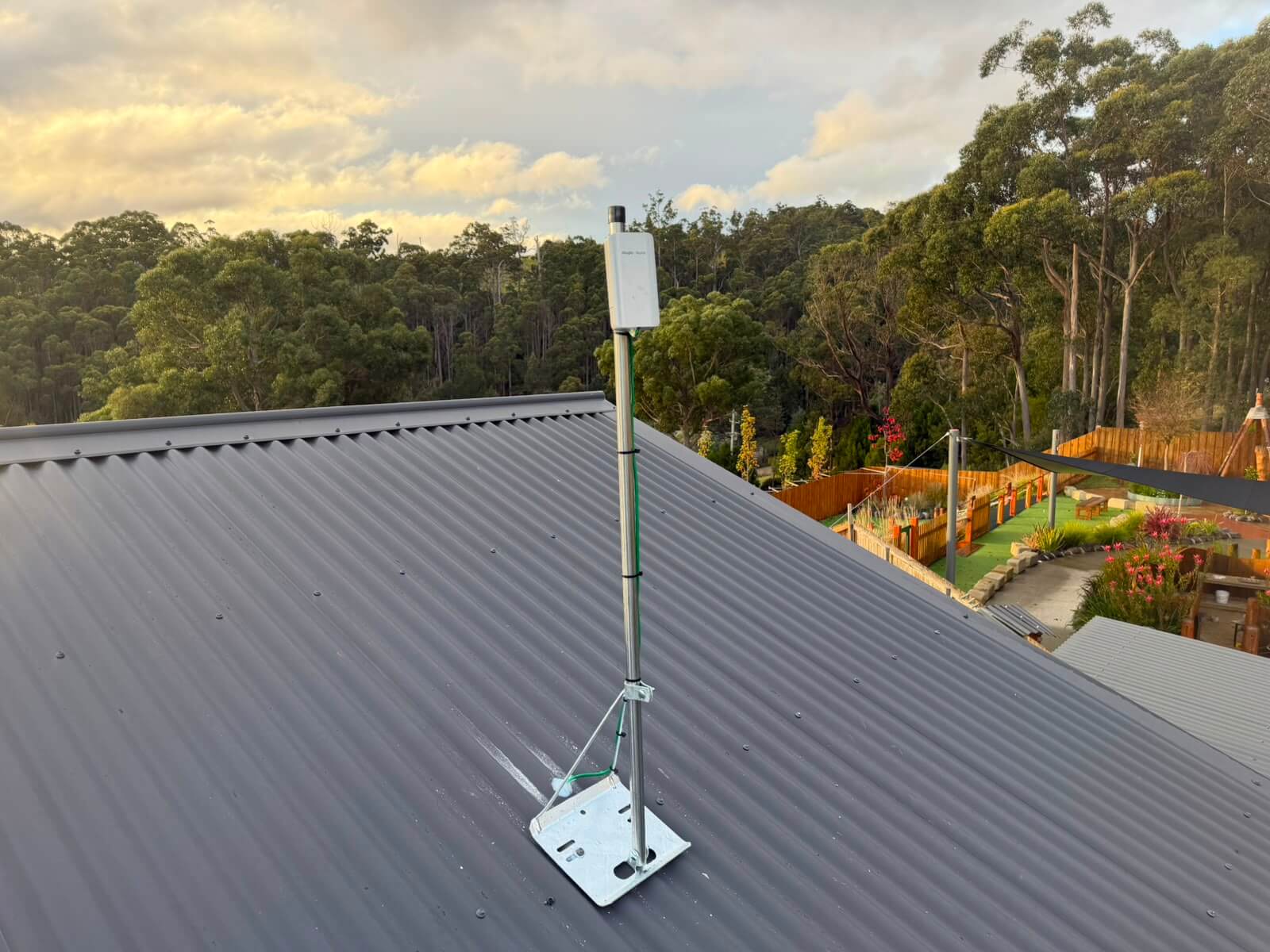
The sender sits on the mast at the house alongside the Starlink dish. The receiver is on its own mast on the childcare centre roof, on a braced base plate with the cable run down and sealed, and aligned by hand until the two ends are genuinely pointed at each other rather than approximately at each other.
Line of sight is the whole game with these. Get it right and the link is invisible in daily use. Get it wrong, or let a row of trees grow into the path over a few seasons, and it will not work at all. That assessment gets done on site before anything is mounted, which is why we look at the property first rather than quoting off a map.
Ceiling mounted access points in both buildings
A link between the buildings is only half of it. What people actually use is the WiFi inside the rooms, and that is where a lot of otherwise decent installs fall down.
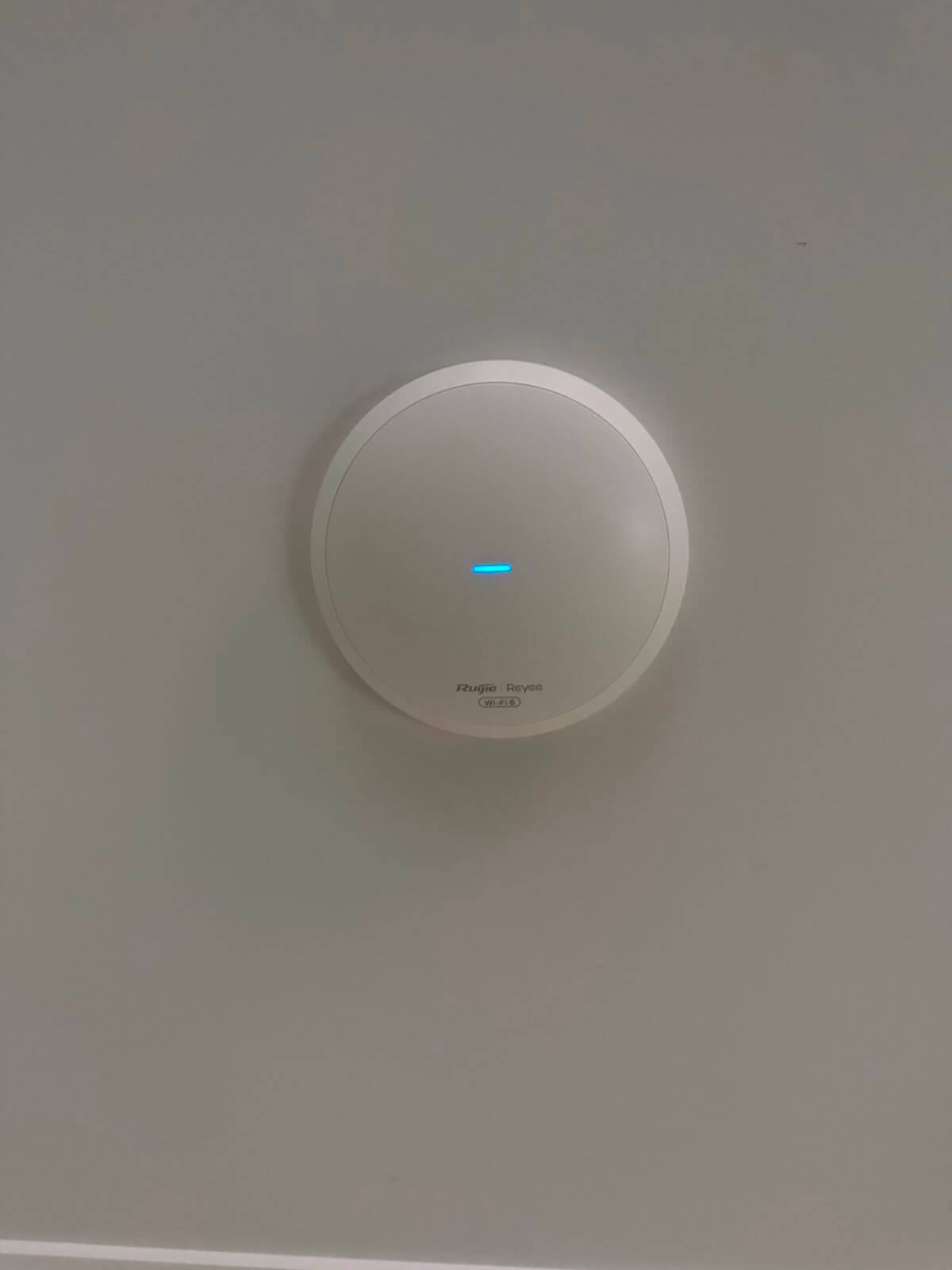
Each building has a Ruijie Reyee WiFi 6 access point mounted flat on the ceiling. They are white, roughly the size of a smoke alarm, and sit flush against the plasterboard with the cabling concealed above it.
For a childcare centre, ceiling mounting matters more than it does in most buildings. There is nothing at child height to pull on, poke at, or knock off a shelf. No plastic box on the wall with a coil of cable hanging out of it. Nothing that has to be explained to a visiting assessor. It is out of reach, out of sight and out of the way, which is exactly where equipment in a room full of small children ought to be.
Mounting on the ceiling also gives better coverage than a router sitting on a bench in the office. Signal spreads down and out across the whole room rather than being blocked by furniture and walls at the same height. The position gets worked out from where the rooms are, then tested in the corners rather than standing underneath the unit.
WiFi 6 matters here too. A childcare room can have a lot of devices going at once. Tablets for sign in and observations, staff phones, a laptop in the office, a speaker, a camera or two. WiFi 6 handles a crowd of devices far better than older gear, which is what you want in a building where twenty things are connected in a small space.
One network, one name, one password
The house access point, the centre access point and the link between them are all configured as a single network, with the same WiFi name and the same password in both buildings.
This is a small detail that makes a real practical difference. Walk from the house to the centre and your phone stays connected the whole way. Nobody drops off one network and hunts for another. There is one password to give a new educator, not two. The sign in tablet, the office laptop and every staff phone all behave the same way in either building.
It also means one system to look after. If anything ever needs adjusting, it is one phone call about one network rather than a guessing game about which building the problem is in.
Where a centre wants it, we can also split a separate guest network off the same system, so parent and visitor devices sit apart from the centre’s own tablets and office computer. That is worth thinking about for any service handling children’s records, and it is a configuration change rather than a second installation.
The result
Muddy Puddles Childcare and Early Learning now runs on one Starlink connection serving two buildings, joined by a point to point wireless link, with WiFi 6 coverage from ceiling mounted access points in both.
The centre’s sign in system, observation app, office computer and staff phones all sit on the same network under one name and one password, and the house is on the same connection. No trench was dug, no second internet service was needed, and there is nothing at child height in any room.
The whole install is backed by our three year warranty.
If you run a childcare centre or early learning service in Southern Tasmania
The same approach suits a lot of services around here, and not only childcare.
It fits any centre operating out of a converted or purpose built building on a residential block, family day care and in home services with a separate studio or annexe, kindergartens and preschools with an outbuilding or a demountable, out of school hours care running from a hall that has never had a cable to it, and any rural service where there is no NBN worth having.
The pattern is nearly always the same. One well positioned satellite connection on whichever building has the clearest sky, a point to point wireless link across to the others, and a ceiling mounted access point inside each one, all tied together as a single network.
From there it is straightforward to add more. Security cameras can run over the same infrastructure without a second cabling job, which is worth knowing if you are looking at coverage of entries, car parks and outdoor play areas. Extra data ports can be run to the office or the sign in point at the same time.
Michael holds ACMA Open and Restricted rule cabling registration with structured cabling, optical fibre and coaxial endorsements, so the cabling side is done to standard rather than improvised. He is also certified to work safely at heights and holds a construction white card, which matters when the roof work is happening on an operating childcare site.
If you have a centre around Huonville, Franklin, Cygnet, Geeveston or anywhere in the Huon Valley that needs internet in more than one building, give Michael a call on 0420 998 592 for a free quote. We cover Hobart, Southern Tasmania and the East Coast, seven days a week from 7am to 6pm.
Installed by Michael Starling
Owner and senior technician, Antenna Installation SpecialistsMichael has been installing Starlink systems across the Huon, the Channel and the Derwent Valley since they became available in Tasmania, and holds ACMA Open and Restricted cabling registration with structured cabling, optical fibre and coaxial endorsements.
All work backed by a three year warranty. Sorell based. Call 0420 998 592 for a free quote.